Showing posts with label Readings. Show all posts

Friday, May 14, 2010

Just Read: Zabbix 1.8 Network Monitoring

Since Zabbix 1.8 came out, I have been wanting to upgrade just for the sake of getting the new and improved AJAXy front-end. Indeed, the Achilles' heel of the previous versions of this otherwise very solid and capable monitoring platform, was the poorly responsive GUI. But I kept pushing the upgrade for a later date.

When the good folks at Packt Publishing offered me to take a peek at their brand new Zabbix book, my procrastination was over. Equipped with such a complete and up-to-date reference material, I had no reason for not taking the plunge and upgrade.

This 400+ pages book is not only welcome as a supporting resource when upgrading, it is also a consummate reference guide that was much needed by all Zabbix users. I've found the book to be easy to read, as it is loaded with screenshots, but also one step beyond than a pure user guide. Indeed, the author covers general subjects about application monitoring: for example, the section on SNMP is actually a very good introduction to this protocol, with tons of hands-on example to guide you through the learning path.

On the down side of things, as it is often the case with technical books, I have found the index to be wanting (it's a little short and sometimes deceiving). This is not a big deal though because, in order to make the most of this comprehensive book, it's a good idea to get the eBook version and use full text search to reach the information needed.

Whether you're using Zabbix and want to deepen your skills or want to learn about monitoring in practice, this book will get you covered. And if you don't want to take my word on this, download this free chapter and see for yourself!

Wednesday, April 28, 2010

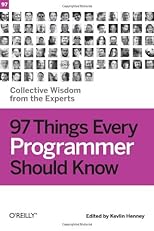
Just Read: 97 Things Every Programmer Should Know


As a collection of 2 pages essays on good software practices, the book offers a pretty heterogeneous reading experience. Despite that, the book is an pleasant and quick read, which covers all aspects of software development, from coding to testing and from technical to human-related concerns.

If you're familiar with the practices that the Agile, XP or Software Craftsmanship movements are putting forward, you'll find that you already knew and agreed with most of the book. In that case, the real value of this book will come from the few essays you'll find questioning or disagreeing with, as you will have to self-introspect and decide if your disagreement is founded or based on prejudices.

In conclusion, I think this book will often be found in the "must read" list of books that teams provide to their junior programmers.

Wednesday, April 14, 2010

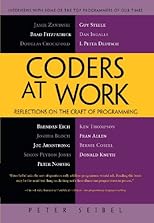
Just Read: Coders at Work


As an interview-based book, Coders at Work does a pretty good job at exploring the minds, memories and practices of an impressive bunch of software old timers.

To me, the main downside of this book is that it is, with a few exceptions, mainly focused on a pretty homogeneous group of people, i.e. US-based coders who started on PDP-*.

The book could have used a little more diversity because it's main value lies in the analysis that us, the readers, will do while reading about the lives of these arch-coders. More diversity would have made the commonality between top coders more salient, while in the book, commonalities feel they occur simply because most of these people worked at the same period of time on the same type of machines.

Besides that, it's definitely worth the read.

Friday, February 27, 2009

Just Read: Statistics Hacks


More than twenty years after my last statistics class, this book really tasted like a rejuvenating read. It is well structured, with an opening focused on theory followed by numerous applications in all sorts of domains (yes, including poker, though my preferred subject was the Drake Equation). As such, the book will stand as a quick reference guide to which the reader will return every now and then.

Recommended for aging minds in need of a refresher (like mine) or curious minds wanting to learn more about statistics and how relevant they are to their every day's life.

As a side note, this is the first e-book I bought: I got it under EPUB format, which renders almost flawlessly on my Sony PSR-700 (texts, figures, schemas are good, very large tables are cut though). Kudos to O'Reilly who do a truly great job with their e-books, providing them in three formats and not limiting you in the number of times you download them (so I don't even bother backing-up my purchases).

Saturday, December 20, 2008

A month of e-reading

After months of procrastination, I have decided to give a try to e-ink and go paperless as much as I can. I have been using a Sony PRS-700 for a month now and I must say I am really happy with it.

This picture does not render the actual contrast and precision of the e-ink surface.

I opted for the Sony reader because of its openness: you plug it in an USB port and voila! You are free to drag and drop files into the reader.

I used it in all sorts of lighting and places: in the dim light and shaky environment of public transportation to the comfort of a sun lit office. So far I successfully used it for:
  • Paperless meetings: instead of printing meetings' material, I now upload them to my reader.
  • Long blog entries: I simply can not read long articles on a computer screen so I use the reader for long blog posts.
  • Reference guides: the search feature of the reader is convenient to find passages of reference guides or technical books (like Mule in Action).
  • Book reviews: instead of printing the books I am reviewing, I now upload them to the reader. The annotation feature is a little too slow to take long notes on pages but fast enough to attach a few words that are reminders for building the final review.
  • Full fledged e-book of course! So far, I have only read a few technical e-books from InfoQ. Hundreds of pages later, I can tell it is really a great reading experience. I sometimes have to zoom on a schema, but most of the time using the landscape orientation guarantees a seamless reading.
Despite wishing a bigger screen for a smaller price (it's Christmas time after all), my only concrete suggestion to Sony would be the addition of a smart zoom mode that would automatically trim all the useless white margins that oftentimes waste PDFs' page estate.

Tuesday, November 11, 2008

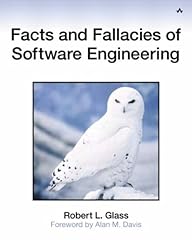
Just Read: Facts and Fallacies of Software Engineering

Sometimes, when I read a book, I look at the publication date and wonder out loud: "what on earth was I doing this year to miss this one?". This is exactly what happened while reading this book from by Robert L. Glass. What on earth was I doing in 2002 to have missed such an excellent book?

Known as the F-Book, after its original title proposition ("Fifty-Five Frequently Forgotten Fundamental Facts (and a Few Fallacies) about Software Engineering", which thankfully was not kept by the editor), this dense book is truly the sum of all truths and untruths about software engineering.

This book is really invaluable as an aid for debunking hype of all sorts and performing reality checks on tools and methods that oftentimes are dumped on software engineers with the promise of a brighter future (that never materializes).

With half a century in the field, Robert has seen it all and heard it all already. If you think your problems or questions are new or unique, then read this book and keep it, because you will have to come back to it and quote it whenever you will need to challenge a snake-oil vendors or an ivory tower methodologists (pretty much like you do with the anti-patterns catalog for development mispractices).

Friday, October 24, 2008

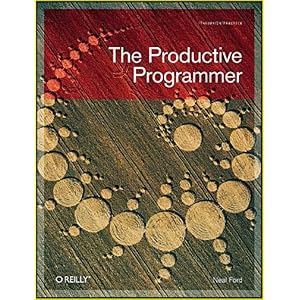
Just Read: The Productive Programmer


In this concise book, Neal Ford shares his hard gained real world experience with software development. Because he is consulting for the best, his experience is diverse and rich, hence definitively worth reading.

This book feels a lot like "The Pragmatic Programmer Reloaded": same concepts with updated samples and situations. It is a perfect read for any junior developer, as the book will instill the right mindset. It is also a recommended book for any developer who struggles with his own practice (all of us, right?) and want to engage the next gear.

Personally, having attended some of Neal's conference speeches and being somewhat an old dog in the field of software, I kind of knew where he would take me in this book hence I did not have any big surprise nor made any huge discovery while reading it. This said, three chapters are truly outstanding and can talk to experienced geeks: "Ancient Philosophers", "Question Authority" and "Polyglot Programming".

Wednesday, October 01, 2008

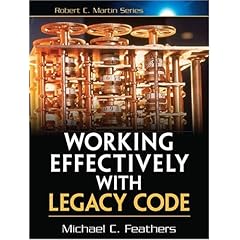
Just Read: Working effectively with legacy code


This book from Michael C. Feathers came at a perfect moment in my software developer's life, as I started to read it right before I came to work on a legacy monstrosity.

The book is well organized, easy to ready and full of practical guidelines and best practices for taming the legacy codebases that are lurking out there.

I really appreciated Michael's definition of legacy code: for him "it is simply code without tests". And, indeed, untested code is both the cause and the characteristic of legacy code.

Near the end of the book, Michael has written a short chapter titled "We feel overwhelmed" that I have found encouraging and inspiring. Yes, working with legacy code can actually be fun if you look at it on the right side. My experience in this domain is that increasing test coverage is elating, deleting dead code and inane comments is bliss and seeing design emerge where only chaos existed is ecstatic.

Conclusion: read this book if you are dealing with today's legacy code or if you do not want to build tomorrow's.

Tuesday, September 16, 2008

Just Read: Clean Code


I have been expecting this new book from Uncle Bob for quite a while so, as soon as I have got my copy, I rushed through it!

If you have no idea about who is this guy named Robert C. Martin and mainly expect people to "sent you teh codez", then you have to read this book. This will not transmogrify you into a craftsman but, at least, you will get a fair measure of the journey you still have to go through and be pointed in the right direction.

If you are familiar with Uncle Bob's writings and attend his conference talks, there will be no new concepts for you in this book. It will still be an insightful reading because of the extensive code samples and the refactoring sessions where you can actually follow the train of thoughts, and the actions they entail, as if you were in the master's head. It's like being John Malkovitch, but a little geekier.

The book itself is somewhat structurally challenged and lacks a little consistency, from a reader standpoint.

But who cares? As long as you can read this kind of stuff:
Clean code is not written by following a set of rules. You don't become a software craftsman by learning a list of heuristics. Professionalism and craftsmanship come from values that drive disciplines.

Robert C. Martin, Clean Code
... is the form so important?

Monday, September 01, 2008

Reading Calendar Irony

My six readers (according to Google Reader), will certainly appreciate the irony of my reading calendar.

Here are the two books I am currently reading:

Isn't this coincidence really fun?

Tuesday, August 26, 2008

Just Read: Managing Humans


Michael Lopps' capacity to deconstruct and analyze every aspects of both software engineering management and nerd internal mechanics is simply outstanding.

This book is not only insightful and amusing, but is a looking glass where all the intricacies of humans' management get revealed.

A. Must. Read.

Wednesday, August 13, 2008

Just Read: Implementation patterns

If you are an aficionado of formal pattern books, you might be disappointed by the latest book from Kent Beck. This book is more about a mentor sharing his experience than a succession of diagrams, code samples and rules for applying or not a particular pattern.

In this book, Kent clearly took the decision to engage the reader in a direct manner: there is no fluff, just the nitty-gritty. Just years of experience and experiments summarized in less than 150 pages. I leave to your imagination to figure out how dense the book is. It is sometimes so rich that I came to wish that a little bit of code or a neat hand-drawn schema could be added here and there, just to make a particular pattern more edible for a slow brain like mine.

There is an intense tension in this book: I have been fulminating after reading some takes from Kent where he states counter intuitive approaches as far as defensive coding is concerned. And then I reached the last part ("Evolving Frameworks") and it striked me: so far in book, Kent was not coding for public APIs. And it striked me again: Kent is a master, he adapts his way of coding to the context.

Let Kent Keck talk to you: buy this short book and listen to what he wants to share with you.

Friday, June 06, 2008

Just Read: Dreaming in code


Dreaming in Code is a scary book, the kind of book that makes you wonder if it is really wise to keep pursuing the vain ambition of writing software. By telling the storing of Chandler, an open source project aimed at revolutionize Personal Information Management tools, the author takes us deep in the moving sands of software development.

The most daunting aspect of the book is the following: if the best developers in the world gathered together under the supervision of a level 5 leader (Mitch Kapor) struggle to build software like the rest of us mortals do our pesky daily jobs, then is there any hope?

Maybe hope is in the unintentional software we build while intending to build something else? We got Ruby on Rails, Blogger and Flickr that way, after all.

Friday, May 16, 2008

Just Read: Release It! and ThoughtWorks Anthology


If you intend to write software that lasts and fares well during its journey, give yourself a hand and read this book. From actual situations, the author derives very concrete recommendations towards writing scalable and operable applications.

As far as I am concerned, reading this book has been an exhilarating experience. Though to a much smaller scale, I have experienced the same pains and came to similar conclusions than the author. Reading some pages entailed some sheer moments of excitement, very much like: "I have been saying the same!".

All in all, I am grateful that Michael Nygard has written such an authoritative book on this crucial matter for now no-one will be allowed to say "I did not know" anymore.


This book does a pretty good job at offering insights and real world feedback from top notch ThoughtWorkers on a variety of software development related subjects (coding, designing, building, QA). For a collection of essays from different authors, the overall uniformity has been pretty well maintained both on style and content.

As a software developer, I have found Neal Ford's "Polyglot Programming" and Jeff Bay's "Object Calisthenics" to be the most compelling pieces of this book.

At the end of the day, the real interest of this anthology resides in the fact that a small consulting firm has decided to share its sheer passion for software in a direct and hype-free manner. How many of the big ones out there could do the same?

Wednesday, March 19, 2008

Just Read: Beautiful Code

Beautiful Code is probably the most unequal software book I have ever read, both in term of style and content. Some chapters are very formal and academic, while others are more relaxed and down to earth. Some chapters really offer food for thought in the matter of software development, while others are arid displays of obscure code with no lesson to gather from. If all the royalties were not given to Amnesty International, I would have felt totally frustrated by this book. At least, I have the feeling to have served a good cause with my money.

Thursday, December 20, 2007

Just Read: Best Kept Secrets of Peer Code Review

Though a company sponsored book, this collection of essays on code review is enlightening. Rooted in the real world, the book makes a clear point for a practice that tends to be overlooked in most of the software shops. A recommended reading for anyone who wants to learn about the state of the art of code review and how it can benefit an organization and its people.

Friday, November 23, 2007

Recently Read

I have read this book cover to cover in just a few commute trips: it is indeed a fascinating reading to discover the ingenuity that hackers employ to abuse on-line games, sometimes for profit, often for fun, and the privacy-invading counter-measures games companies put in place. An eye opener for anyone playing on-line games who would not be willing to share all his private information with vendors.

A very good introduction to Erlang, which really invites you to start building resilient and parallel applications. I was amazed to see the similarity between Erlang's pattern matching philosophy and RuleML's.