Ross Mason has interviewed John D'Emic and I about Mule in Action.
If you listen to the podcast, you will get a 27% discount voucher as a compensation for ear damages caused by my broken English.
Isn't life a bliss?
Monday, November 24, 2008
Monday, November 17, 2008
Seven Years To Rot
So here we are, seven years after the Manifesto, and the webersphere is pontificating about the decline of agile, to the point that Uncle Bob has hard time containing his anger in front of such a display of nonsense and dishonesty.
What is going on with agile? After seven years of existence (I know, the techniques and approaches agile promotes predate the Manifesto), has it started to rot?
Some suggest that agile is following the Gartner hype-cycle and has now past its "peak of inflated expectations":

Of course, there is hype around agile and the diatribe of some of its fanatics can be a little over the top. But I think that the current "decline" in agile is not due to some disillusionment.
I think this so-called "decline" comes from the numerous software sweat shops and less-than average programmers who started to pretend they do "agile" without changing anything in their craftsmanship. Instead of a disillusionment, agile suffers from dilution.
Hopefully, people will be able to sort the wheat from the chaff and debunk these agile fraudsters. When this will happen, agile will start climbing its "slope of enlightenment".
What is going on with agile? After seven years of existence (I know, the techniques and approaches agile promotes predate the Manifesto), has it started to rot?
Some suggest that agile is following the Gartner hype-cycle and has now past its "peak of inflated expectations":
Of course, there is hype around agile and the diatribe of some of its fanatics can be a little over the top. But I think that the current "decline" in agile is not due to some disillusionment.
I think this so-called "decline" comes from the numerous software sweat shops and less-than average programmers who started to pretend they do "agile" without changing anything in their craftsmanship. Instead of a disillusionment, agile suffers from dilution.
Hopefully, people will be able to sort the wheat from the chaff and debunk these agile fraudsters. When this will happen, agile will start climbing its "slope of enlightenment".


Thursday, November 13, 2008
The Path of Least Resistance
While fighting with monsters of legacy code, I have kept thinking of all the possible reasons why developers would end up building such a man-made hell. My capacity to analyze the situation and figure out possible causes is limited to the knowledge of the external forces that these developers where exposed to. For what was happening inside of them, I am limited to build analogies after looking at my own battles and shortcomings.
I have been trying to distill a unique question. Here it is: why would a developer choose to the walk the path of least resistance?
Though skill, experience and professional standards are factors at play, I do not think they can explain the whole picture. Deadline pressure certainly encourage to cut corners and follow the easiest and dirtiest path. But the crux of the problem is not there. It is in the resistance.
What is this resistance anyway? It is multiform and hard to characterize. Any developer surely has felt at least once the slight despair it entails: you want to progress and get blocked by a wall of resistance that is not insurmountable but would incur a great cost in term of work disturbance.
Here are a few example of the outcome produced by such a resistance:
Taking intelligent decisions while being goal driven is hard. Everybody knows that the path of least resistance is rarely the best one. Alas, we walk it and, I suspect, not by laziness but by renouncement.
I have been trying to distill a unique question. Here it is: why would a developer choose to the walk the path of least resistance?
Though skill, experience and professional standards are factors at play, I do not think they can explain the whole picture. Deadline pressure certainly encourage to cut corners and follow the easiest and dirtiest path. But the crux of the problem is not there. It is in the resistance.
What is this resistance anyway? It is multiform and hard to characterize. Any developer surely has felt at least once the slight despair it entails: you want to progress and get blocked by a wall of resistance that is not insurmountable but would incur a great cost in term of work disturbance.
Here are a few example of the outcome produced by such a resistance:
- Teams entrenched behind layers of management feel encouraged not to wait for the others to do something that they need and end-up building sub-optimal solutions with what they have now.
- High cost of database changes can drive developers to extremes like the reuse of existing fields, the use of inadequate field types or the storage of serialized objects in BLOBs when a few extra columns would have done the trick.
- Long feedback loops between a code change and the result of testing orient developers towards implementing new features with minimal changes to existing code, which ends up with code duplication, spaghetti plates and design-less applications.
Taking intelligent decisions while being goal driven is hard. Everybody knows that the path of least resistance is rarely the best one. Alas, we walk it and, I suspect, not by laziness but by renouncement.
Tuesday, November 11, 2008
Just Read: Facts and Fallacies of Software Engineering
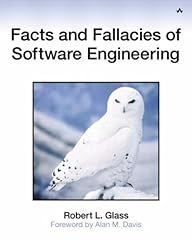 Sometimes, when I read a book, I look at the publication date and wonder out loud: "what on earth was I doing this year to miss this one?". This is exactly what happened while reading this book from by Robert L. Glass. What on earth was I doing in 2002 to have missed such an excellent book?
Known as the F-Book, after its original title proposition ("Fifty-Five Frequently Forgotten Fundamental Facts (and a Few Fallacies) about Software Engineering", which thankfully was not kept by the editor), this dense book is truly the sum of all truths and untruths about software engineering.
This book is really invaluable as an aid for debunking hype of all sorts and performing reality checks on tools and methods that oftentimes are dumped on software engineers with the promise of a brighter future (that never materializes).
With half a century in the field, Robert has seen it all and heard it all already. If you think your problems or questions are new or unique, then read this book and keep it, because you will have to come back to it and quote it whenever you will need to challenge a snake-oil vendors or an ivory tower methodologists (pretty much like you do with the anti-patterns catalog for development mispractices).
Monday, November 10, 2008
Silver Still Very Light
I have just switched to the latest version of Moonlight, the port of Microsoft Silverlight on Linux, and the least I can say is that things have significantly progressed since the last time I tried.
So far, I have found only one site of use whose Silverlight application runs fine on Linux: the Ryanair destination map. Though the plug-in reports a rendering speed of close to 100 FPS, the zooming and panning is still way behind what pure JavaScript or Flash applications provide. But it is very impressive already.
The only problem seems to reside in the Silverlight detection algorithm used by most of the sites. Most of them give me the Redmond finger:

... while Moonlight is there and ready to chew XAML and render it! Too bad, I would like to see more of these sites and keep track on how this runner up technology will compete with the ones already in place.
At the end of the day, I have no doubt Silverlight/Moonlight can become a credible alternative to the current RIA browser-side technologies. My main concern is that sloppy developers may create Silverlight-powered sites that will only work with a limited set of platforms (browsers, OSes), which would be a regression from the current state of the web nation.
Saturday, November 08, 2008
Where the hell is... Alineo?
After Matt and his little dance, my brother in law, of VoilaSVN fame, has decided to go freelining worldwide.
Two episodes so far: the classic grand Canyon and the way more exotic Luxembourg.
Enjoy.
Two episodes so far: the classic grand Canyon and the way more exotic Luxembourg.
Enjoy.
Friday, November 07, 2008
Reality Check Levels
I am in a "question everything" phase. Maybe it is a side-effect of reading the excellent F-book (review coming soon) or the outcome of learning about the software half-life hypothesis? All in all, I am more and more dubious about what I read and hear about in the field of software. I have grown tired of half-baked ideas (including mine) that present possibilities as realities and niche solutions as widely applicable ones.
It seems this is natural: smart people have started to change their views on important subjects. Since I am not that smart, I would like reviewers of articles and publications to add something like the color-coded terrorist threat level to indicate the reality-check level of what I am reading.
That could be something like:
Like the threat level, this scale is coarse and over simplistic. Would you like it anyway? Would you had more levels?
It seems this is natural: smart people have started to change their views on important subjects. Since I am not that smart, I would like reviewers of articles and publications to add something like the color-coded terrorist threat level to indicate the reality-check level of what I am reading.
That could be something like:
RC0: This is highly hypothetical material. Mainly works in the vendor's environment, on the open source committer's laptop or in the researcher's lab.
RC1: This plays well in the F100 or governmental field. Complex committee-driven years-long BDUF-minded expensive concepts can be applied here. But nowhere else.
RC3: This is the field of pragmatists. The ideas, methodologies or products are based on simple, well-established and proven concepts.
Like the threat level, this scale is coarse and over simplistic. Would you like it anyway? Would you had more levels?
Thursday, November 06, 2008
Legacy Tests
In Working Effectively with Legacy Code, Michael Feathers states that, for him, "legacy code is simply code without tests". As he says it himself, he has "gotten some grief for this definition". I can understand why.
I have come to deal with some legacy code monsters recently and came to realize that this code had tests written for it. So could it be that this code was not legacy after all?
After a closer inspection, the truth finally came out:
Else you will end up with nearly worthless legacy tests.
I have come to deal with some legacy code monsters recently and came to realize that this code had tests written for it. So could it be that this code was not legacy after all?
After a closer inspection, the truth finally came out:
- the test coverage is very low (less than 30%),
- the tests explore counter-intuitive paths (for example, just the unhappy ones),
- the tests themselves are monstrous (created in what looks like a copy/paste spree),
- they overuse mocks in a lax manner (many are not verified at tear down),
- they do not verify the complete state after execution (no validation of indirect outputs like request and session attributes),
- and, corollary of the legacy framework the code targets (EJB 2), full correctness can only be proven when deployed in an application container.
Else you will end up with nearly worthless legacy tests.
Tuesday, November 04, 2008
Two third of a Mule in Action
I am happy to report that two third of Mule in Action is now available from Manning's Early Access Program.
If you were deferring buying the book, now is a great time to part from a few bucks and get it! Indeed, you will find in these 280 pages a lot of practical knowledge about Mule that John and I have put together for your utmost enjoyment!

And just to thank you for spending your time reading this blog, I will share a little secret with you. If you use the aupromo25 promo code when buying the book, you will get 25% off the price. But please, don't repeat it.
Finally, just so you don't think it is all about money, you can always get the source code for the book for free. That is zero Dollar, which is also zilch Euro and no much more of any other currency you happen to have in your pocket.
If you were deferring buying the book, now is a great time to part from a few bucks and get it! Indeed, you will find in these 280 pages a lot of practical knowledge about Mule that John and I have put together for your utmost enjoyment!
And just to thank you for spending your time reading this blog, I will share a little secret with you. If you use the aupromo25 promo code when buying the book, you will get 25% off the price. But please, don't repeat it.
Finally, just so you don't think it is all about money, you can always get the source code for the book for free. That is zero Dollar, which is also zilch Euro and no much more of any other currency you happen to have in your pocket.
Saturday, November 01, 2008
JBound 1.1 is out
I have just released version 1.1 of JBound, my simple utility that performs boundary checks on domain model objects.
This new release features native support for more JDK data types and the possibility to register custom data types.
Consult the daunting one page user guide for more information.
This new release features native support for more JDK data types and the possibility to register custom data types.
Consult the daunting one page user guide for more information.
Friday, October 24, 2008
SpringSource's Elitism
SpringSource community is elitist and despises juniors. Here is the captcha I just go on their forums:
 Why so much hatred? Seriously guys?
 Why so much hatred? Seriously guys?
Half Life And No Regrets
In the latest edition of the excellent IEEE Software magazine, the non less excellent Philippe Kruchten has conjectured about the existence of a five years half-life for software engineering ideas. That would mean that 50% of our current fads would be gone within five years.
Though not (yet) backed by any hard numbers, his experience (as mine and yours) suggest that this is most probably true.
All in all, the sheer idea of such an half-life decay pattern helps letting obsolete knowledge go without regret. It is fine to forget everything about EJBs and code with POJOs. JavaBeans are evil: you can come back to pure OO development. You can bury your loved-hated-O/R-mapper skillset in favor of writing efficient SQL. It is OK to drop the WS-Death* for REST (this one is purposefully provocative, if a WS-nazi reads this blog I am dead).
Unlearning things that were so incredibly painful to learn may feel like a waste but it is not. This half-life decay is in fact great news because it translates into less knowledge overload and more focus on what matters... or, unfortunately, the adoption of new short-lived fads! And the latter is the scariest part. How much about what we are currently learning will survive more than five years?
Nothing platform or even language specific, I would say. But sound software engineering practices will remain: building elevated personal and professional standards, treasuring clean code, challenging our love for hype with the need for pragmatism...
This is where our today's investment must be: in the things that last.
Just Read: The Productive Programmer
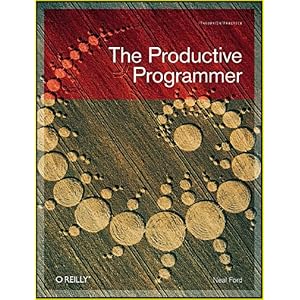
In this concise book, Neal Ford shares his hard gained real world experience with software development. Because he is consulting for the best, his experience is diverse and rich, hence definitively worth reading.
This book feels a lot like "The Pragmatic Programmer Reloaded": same concepts with updated samples and situations. It is a perfect read for any junior developer, as the book will instill the right mindset. It is also a recommended book for any developer who struggles with his own practice (all of us, right?) and want to engage the next gear.
Personally, having attended some of Neal's conference speeches and being somewhat an old dog in the field of software, I kind of knew where he would take me in this book hence I did not have any big surprise nor made any huge discovery while reading it. This said, three chapters are truly outstanding and can talk to experienced geeks: "Ancient Philosophers", "Question Authority" and "Polyglot Programming".
Saturday, October 18, 2008
Two-Minutes Scala Rules Engine
Scala is really seductive. To drive my learning of this JVM programming language, I thought I should go beyond the obvious experiments and try to tackle a subject dear to my heart: building a general purpose rules engine.
Of course, the implementation I am going to talk about here is naive and inefficient but the rules engine is just a pretext here: this is about Scala and how it shines. And it is also a subset of what Scala is good at: I mainly scratch the surface by focusing on pattern matching and collections handling.
The fact representation I use is the same than the one used by RuleML: a fact is a named relationship between predicates. For example, in "blue is the color of the sky", color is the relationship between blue and sky. The rules engine matches these facts on predefined patterns and infers new facts out of these matches.
In Scala, I naturally opted for using a case class to define a fact, as the pattern matching feature it offers is all what is needed to build inference rules:
Normally you do not need to implement your own hashcode functions, as Scala's default ones are very smart about your objects' internals, but there is a known issue with case classes that forced me to do so.
For rules, I opted to have them created as objects constrained by a particular trait:
The method of note in this trait is run which accepts a list of n facts and returns zero (None) or one (Some) new fact ; with n equals to the value of the arity function.
So how is the list of facts fed to the rule run method created? This is where the naive and inefficient part comes into play: each rule tells the engine the number of facts it needs to receive as arguments when called. The engine then feeds the rule with all the unique combinations of facts that match its arity.
This is an inefficient but working design. The really amazing part here is how Scala shines again by providing all what is required to build these combinations in a concise manner. This is achieved thanks to the for-comprehension mechanism as shown here:
Notice how this code is generic and knows nothing about the objects it combines. With this combination function in place, the engine itself is a mere three functions:
With this in place, let us look at the facts and rules I created to solve the classic RuleML discount problem (I added an extra customer). Here is the initial facts definition:
And here are the two rules:
With this in place, calling:
produces this new fact base with the correct discount granted to good old Peter Miller but not to the infamously cheap John Doe:
This is truly a two minutes rules engine: don't ship it to production! Thanks to the standard pattern matching and collection handling functions in Scala, this was truly a bliss to develop. On top of that, Scala's advanced type inference mechanism and very smart and explicit compiler take strong typing to another dimension, one that could seduce ducks addicts.
So why does Scala matter? I believe the JVM is still the best execution platform available as of today. It is stable, fast, optimized, cross-platform and manageable. An alternative byte-code compiled language like Scala opens the door to new approaches in software development on the JVM.
Closing note: an interesting next step will consist in parallelizing the engine by using Scala actors. But this is another story...
Wednesday, October 08, 2008
Database Cargo Cult
Today, I have attended an epic product walk-through. When the demonstrator came to explore the database of the application and opened the stored procedures directory, the audience was aghast at the shocking display of hundreds of these entities. I have been told it is the canonical way of developing applications in the Microsoft world. It is well possible, as it creates a favorable vendor coupling, but, to me, it is more a matter of database cargo cult.
The fallacy of the database as an application tier is only equated by the folly of using it as an integration platform. Both approaches create a paramount technical debt that takes many years to pay, if it is ever paid. Why? Because both approaches lack the abstraction layer that you need to create loosely coupled systems. Why again? Because both approaches preclude any sound testing strategy.
I have already talked about what I think are valid use cases for stored procedures. You do not need to believe me. Check what my colleague Tim has to say about it. And you do not need to believe him either, but at least read what Neal Ford says about it.
If you are still not convinced, then I have for you the perfect shape for your diagrams:
 1BDB stands for one big database. And if you are in a database cargo cult, you already know why it is in flame.
Thursday, October 02, 2008
Jolting 2008
The doors are now open for the 2008 Jolt Product Excellence Awards nominations.
If you have a great book or a cool product that has been published or had a significant version release in 2008, then do not wait any longer and enter the competition!
Oh, did I mention that early birds and open-source non-profit organizations get a discount?
If you have a great book or a cool product that has been published or had a significant version release in 2008, then do not wait any longer and enter the competition!
Oh, did I mention that early birds and open-source non-profit organizations get a discount?
Wednesday, October 01, 2008
Just Read: Working effectively with legacy code
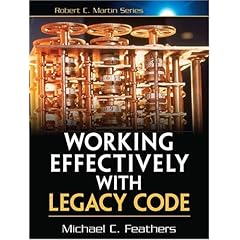
This book from Michael C. Feathers came at a perfect moment in my software developer's life, as I started to read it right before I came to work on a legacy monstrosity.
The book is well organized, easy to ready and full of practical guidelines and best practices for taming the legacy codebases that are lurking out there.
I really appreciated Michael's definition of legacy code: for him "it is simply code without tests". And, indeed, untested code is both the cause and the characteristic of legacy code.
Near the end of the book, Michael has written a short chapter titled "We feel overwhelmed" that I have found encouraging and inspiring. Yes, working with legacy code can actually be fun if you look at it on the right side. My experience in this domain is that increasing test coverage is elating, deleting dead code and inane comments is bliss and seeing design emerge where only chaos existed is ecstatic.
Conclusion: read this book if you are dealing with today's legacy code or if you do not want to build tomorrow's.


Tuesday, September 30, 2008
Can Mule Spring further?
Just wondering.
Mule 2 is already very Spring-oriented, or at least very Spring-friendly. Will Mule's distribution, which is currently a nice set of Maven-build artifacts, evolve to a set of OSGI bundles a la Spring for version 3?
If MuleSource follows that path and distributes Spring Dynamic Modules, that would allow people to run on the SpringSource dm Server, if they want it, and benefit from sweetnesses like hot service replacement.
I doubt that Mule could use SpringSource dm Server as a default platform unless they clear up what I think could be licensing incompatbilities. But end users could make that choice and put the two Sources, Mule and Spring, together.
Just wondering.
Wednesday, September 24, 2008
The Build Manifesto
My ex-colleague Owen has just introduced the Build Manifesto. I invite you to read it and share your thoughts with him.

Subscribe to:
Posts (Atom)